
Documents to Check Before Buying a Plot in Mysore
The short answer
Before buying a site in Mysore, insist on the title deed and full ownership chain, a 30-year encumbrance certificate, the khata certificate and extract, current tax receipts, the approved layout plan, and — for land that was agricultural — the DC conversion order. Have an advocate examine all of them before you pay an advance.
Key takeaways
- The encumbrance certificate and the title chain are the two documents that matter most. Get both, for at least 30 years.
- A site marketed as "approved" means nothing until you see the approved layout plan and the release order.
- If the land was agricultural, no conversion order means no legal residential use — regardless of what has been built around it.
- Khata A and khata B are not interchangeable. Check which one the site actually has.
- Ask for originals, not photocopies, and have an advocate verify them before any money moves.
Most bad property purchases in and around Mysore are not the result of overpaying. They are the result of buying a site whose paperwork did not support what the buyer thought they were getting. This checklist is what we go through before we are comfortable recommending a site to anyone.
Give the whole set to an advocate. Reading them yourself is useful; it is not a substitute.
1. Title deed and the chain of ownership
The current registered sale deed shows how the present owner acquired the property. Behind it should be a continuous chain — the "mother deed" and every transfer since — establishing that each owner in turn had the right to sell. Ask for at least thirty years of chain. Gaps, unregistered transfers, or a property that has passed through inheritance without a clear partition deed all need explaining before you proceed.
2. Encumbrance certificate (30 years)
Obtained from the sub-registrar, the EC lists every registered transaction against the property over the period requested. You are looking for two things: that the chain matches the deeds you have been shown, and that there is no subsisting mortgage, lien, court attachment or third-party claim. If the property was mortgaged and the loan repaid, you also want the release deed or discharge certificate from the lender.
3. Khata certificate and khata extract
The khata is the municipal record identifying who is responsible for property tax. The certificate confirms the property is on the register in the owner's name; the extract gives the details — dimensions, built-up area where applicable, and assessed value.
Check which type of khata the property holds. The distinction between A and B khata affects building licences, loan eligibility and resale, and the rules around it have changed over time — see our khata guide and confirm the current position with the local body.
4. Property tax paid receipts
Get the receipts for the most recent years, in the seller's name, with no arrears. Unpaid property tax follows the property, not the previous owner.
5. Land conversion (DC conversion) order
A great deal of land around Mysore was agricultural. To be used for residential purposes it must be converted to non-agricultural use by order of the competent authority. Without that order the site cannot lawfully be built on for residential use, you will have difficulty obtaining a building licence, and most lenders will not finance it.
If the land was never agricultural, this does not apply — but confirm that rather than assume it.
6. Approved layout plan and release order
For a site inside a layout, ask for the layout plan approved by the planning authority, and the release order covering the specific site number you are buying. Then verify the approval directly with the authority. A layout plan shown to you on a phone is not verification.
Our MUDA guide explains what approval does and does not guarantee.
7. Survey documents
- Survey sketch / tippani — the official sketch of the survey number.
- RTC (Pahani) — for land that is or was agricultural, showing the record of rights, tenancy and crops.
- Mutation records — showing that ownership changes have been recorded in the revenue records.
Measure the site yourself against the sketch. Discrepancies between recorded and actual dimensions are common and must be resolved before purchase, not after.
8. Situation-specific documents
| Situation | Additional documents |
|---|---|
| Property developed under a joint development agreement | JDA, area-sharing agreement, and the general power of attorney relied on |
| Sale through a power of attorney | The registered POA, proof the principal is alive and the POA is unrevoked |
| Inherited property | Succession or legal-heir certificate, partition deed, and consent of all heirs |
| Property held by a company or firm | Board resolution or partner authorisation permitting the sale |
| Site with existing construction | Sanctioned building plan and, for apartments, the occupancy certificate |
| Agricultural land | RTC, mutation extract, and confirmation of the buyer's eligibility to purchase |
9. What to check on the ground
Documents describe the property. A visit tells you whether the description is true.
- Do the physical boundaries match the schedule in the deed?
- Is the access road the one shown on the layout plan, and is it the width stated?
- Is there any encroachment — a compound wall, a shed, a path in use?
- Is anyone in possession of the site?
- Does the site drain, or does water stand on it?
- What is the water source in that street, and what is the power situation?
Red flags
- The seller will only show photocopies, or is "getting the originals from the bank".
- Urgency framed as a favour — a price valid only if you pay an advance today.
- A price meaningfully below comparable sites, with no explanation you can verify.
- Any request to record a lower value in the deed than the amount actually paid.
- Reluctance to let your advocate see the file.
Getting a second pair of eyes
We go through this list on every site we recommend, and we will tell you when something does not add up. Send us your requirement or ask us about a specific site — there is no charge to customers.
This guide is general information, not legal advice. Engage an advocate to examine the actual documents for the property you intend to buy.
Frequently asked questions
What is an encumbrance certificate and why does it matter?
An encumbrance certificate (EC) is a record from the sub-registrar of transactions registered against a property over a given period — sales, mortgages, gifts, court attachments. A clean EC for at least 30 years tells you the ownership chain is what the seller says it is and that there is no undisclosed loan or claim sitting on the property. A gap in the EC is a question you must get answered before proceeding.
Can I buy a site that does not have a conversion order?
If the land was originally agricultural and has not been converted to non-agricultural use, it cannot lawfully be used for residential construction, and you will struggle to get a building licence, a bank loan or a clean resale. That other houses have been built nearby is not evidence that conversion exists. Ask for the conversion order.
How do I check whether a layout is approved?
Ask for the approved layout plan issued by the planning authority, along with the release order for the specific site. Then verify the approval independently with the authority rather than relying on the copy you were handed. Any genuine seller will expect this.
Is a khata certificate the same as ownership?
No. Khata is a municipal record for property tax purposes — it identifies who is liable to pay tax on the property. It is important, and you need it, but it is not proof of title. Title comes from the registered deeds and the chain behind them.
Properties related to this guide
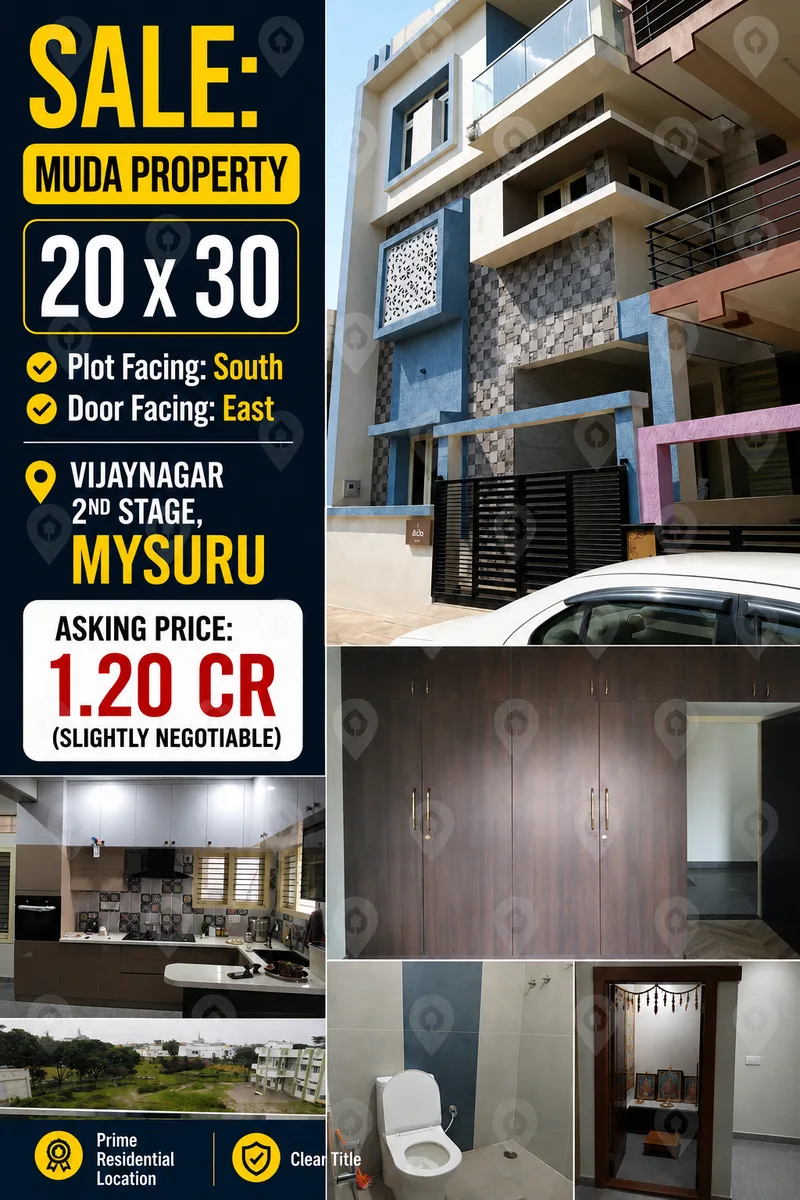
₹1.2 Crore
20 x 30 Triplex House, Vijaynagar 2nd Stage, Mysuru
Vijayanagar 2nd Stage, Mysore
- Independent House
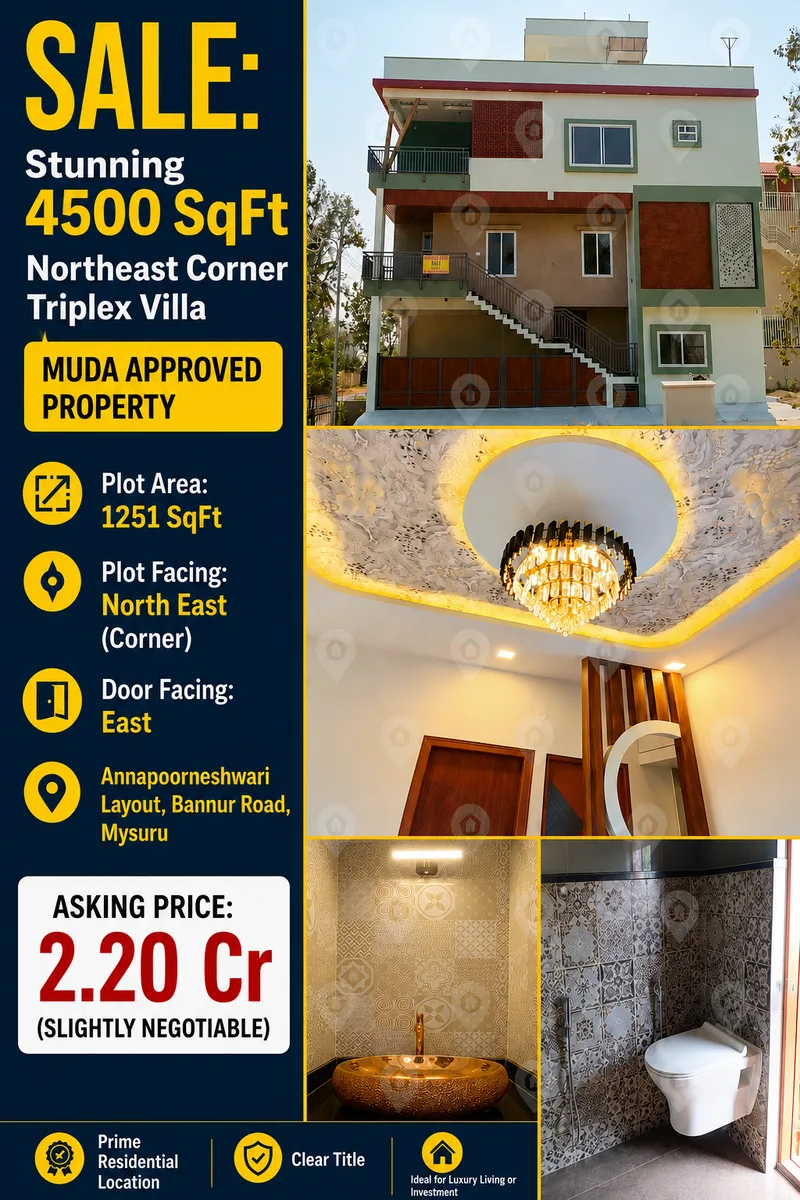
₹2.2 Crore ₹4,889 per sq.ft
Stunning 4500 SqFt Built Triplex Villa, North East Corner on Bannur Road, Mysore
Annaporneshwari Layout, Mysore
- 4,500 sq.ft built-up
- 1,251 sq.ft plot
- Independent House

₹25 Lakh ₹6,250 per sq.ft
20 x 20, MUDA Property, Raghavendra Nagar, Mysuru, Urgent Sale
Raghavendra Nagar, Mysore
- 400 sq.ft plot
- 20 x 20
- Independent House
Want help applying this to your own search?
Send us your requirement and we'll shortlist properties that fit, arrange the visits and flag the things this guide says to check. No platform fee for customers.
Reviewed and updated 27 August 2026. How we research and review guides.