
What 'MUDA Approved' Means in Mysore
The short answer
A MUDA-approved site sits in a layout formally approved by the Mysore Urban Development Authority, which makes building licences, bank loans and resale straightforward. A non-approved site may be cheaper but can be harder to build on, harder to finance and harder to sell on. Verify approval with the authority — not with the seller.
MUDA approved: the one-sentence answer
A MUDA-approved property sits in a layout formally sanctioned by the Mysore Urban Development Authority, with roads, drains and civic amenity space accounted for in the approved plan. Non-MUDA property has no such sanction.
Key takeaways
- MUDA approval relates to the layout, not to the quality of the individual site or the house on it.
- Approval materially affects three practical things: building licence, bank finance and resale liquidity.
- Ask for the approved layout plan and the release order for your specific site number, then verify with the authority.
- A discount on a non-approved site is the market pricing a real risk, not a bargain nobody else noticed.
- Approval is separate from khata, from land conversion and from RERA. You need to check each one.
If you are looking at residential sites in Mysore, "MUDA approved" is the phrase you will hear most, and it is the phrase most often used loosely. It is worth understanding precisely what it covers — and, just as importantly, what it does not.
What MUDA approval is
The Mysore Urban Development Authority is the planning authority for Mysore and its surrounding development area. When a layout is formed, the plan has to be approved by the authority: the road widths, the drainage, the reservation of land for parks and civic amenities, and the release of individual sites for sale.
A site described as MUDA approved is a site in such a layout, released by the authority. That is the whole of the claim. It says nothing about the title chain, the soil, the construction on the plot, or whether the price is fair.
Why it matters in practice
| Consequence | Approved layout | Unapproved layout |
|---|---|---|
| Building licence | Standard process with the local body | Often difficult or unavailable |
| Bank finance | Generally straightforward | Restricted; some lenders decline outright |
| Resale | Wide buyer pool | Smaller pool, longer sale, price discount |
| Civic infrastructure | Roads, drains and amenity space planned in | Varies; sometimes retrofitted, sometimes not |
| Risk of future action | Low | Depends on the nature of the deviation |
The finance point is the one that catches buyers out. People often plan to buy the site with savings and build with a construction loan later — and then find the lender will not finance construction on an unapproved plot.
How to verify approval properly
- Ask the seller for the approved layout plan and the release order covering your specific site number.
- Note the layout name, the survey number and the approval reference.
- Verify with the authority directly. Do not rely on a document handed to you, however official it looks.
- Have your advocate confirm the approval position as part of the title opinion.
A genuine seller expects this and will help. Resistance at this step is itself information.
Approval is one of four separate checks
Buyers frequently collapse these into one idea. They are distinct, and a site can pass one and fail another:
- Layout approval — is the layout approved by the planning authority?
- Land conversion — if the land was agricultural, has it been converted for non-agricultural use?
- Khata — is the property on the municipal register, and under which classification? See our khata guide.
- RERA — for qualifying projects, is the project registered with the Karnataka authority?
Our document checklist covers all of these in order.
Should you ever consider a non-approved site?
Some buyers do, with their eyes open — usually where the land is intended for long-term holding rather than immediate construction, where no loan is involved, and where an advocate has confirmed the title is otherwise sound.
What you should not do is treat the discount as free money. The gap in price exists because the market has priced a real set of constraints: financing, licensing and future liquidity. If you cannot articulate why the discount is worth those constraints for your specific situation, the answer is no.
How we handle this on our listings
Where a property on Find My Property shows a MUDA status, it is the status stated to us by the owner or representative, recorded as stated. We show it because it is material; we do not present it as independently verified unless a specific check has been completed and recorded. Our verification standards set out exactly what each badge means.
This guide is general information about how approval affects a purchase. It is not legal advice, and approval rules and regularisation schemes change. Verify the current position with the authority and take advice from an advocate for the specific property.
What MUDA approval does and does not guarantee
Approval tells you the layout was sanctioned and the plan provides for roads, drainage and civic amenity space. It does not tell you the roads have been laid, that the seller owns the site, or that the khata is clean. Those are separate checks, and an approved layout with none of them done is still a difficult purchase.
How to verify a site's MUDA status yourself
Ask the seller for the approved layout plan number and the sanction letter, then check it against MUDA directly rather than against the brochure. Cross-read the khata and the encumbrance certificate — an approved layout with a khata in someone else's name is not a site you can buy today. Where the answer matters to the price, get it in writing before any advance changes hands.
Common phrases explained
MUDA layout — a layout the authority sanctioned. MUDA allotted — a site the authority itself allotted to an individual, usually with conditions attached for a period. MUDA converted is not a MUDA term at all: conversion of agricultural land is a Deputy Commissioner order, and a listing using the phrase is worth a question.
Check it at source
Approval status is a matter of record. Check it against the authority itself rather than a listing:
Mysore Urban Development Authority (MUDA)
The authority that sanctions layouts, allots sites and publishes e-auction notifications in Mysuru.
Kaveri Online Services, Department of Stamps and Registration, Government of Karnataka
The state registration portal — property registration appointments, encumbrance certificates, certified copies and the guidance-value lookup.
Mysuru City Corporation
The city corporation, responsible for khata and municipal property tax inside city limits.
Fees, dates and document lists are set by these authorities and change. Where this guide describes a procedure, the notification or the department's own page is the authority — not this page.
Read next
Frequently asked questions
What does MUDA approval actually mean?
It means the Mysore Urban Development Authority has approved the layout in which the site sits — the plan, the road widths, the civic amenity reservations and the release of individual sites. It is an approval of the layout, not a certification of the title, the soil or any building on the plot.
Can I get a home loan on a non-MUDA site?
It is harder. Many lenders restrict or decline finance on sites in unapproved layouts, and those that lend may offer a lower loan-to-value ratio. Ask your lender about the specific property early, before you commit to an advance.
Can a non-approved layout be regularised later?
Regularisation schemes have existed at various times in Karnataka, with changing conditions and windows. Do not buy on the assumption that a scheme will be available when you need it. Treat any future regularisation as a possibility, not a plan.
Is MUDA approval the same as khata A?
No. Approval concerns the layout; khata is a municipal tax record for the individual property. A site can be in an approved layout and still have its khata pending, and khata classification has its own consequences. Check both.
What does MUDA approved mean?
That the layout the site sits in was formally sanctioned by the Mysore Urban Development Authority, with roads, drains and civic amenity space provided for in the approved plan.
What is the full form of MUDA in real estate?
Mysore Urban Development Authority — the statutory body that plans and sanctions layouts in and around Mysuru.
Is a non-MUDA site illegal?
Not necessarily. It may be sanctioned by a panchayat or another authority, or it may be a revenue site with no layout approval. What differs is how it is treated for loans, building sanction and resale — which is why the status is worth establishing in writing.
Does MUDA approval make a site more expensive?
It generally does, because it changes what can be done with the site. Whether the premium on a particular site is fair is a separate question from whether the approval is real.
Properties related to this guide
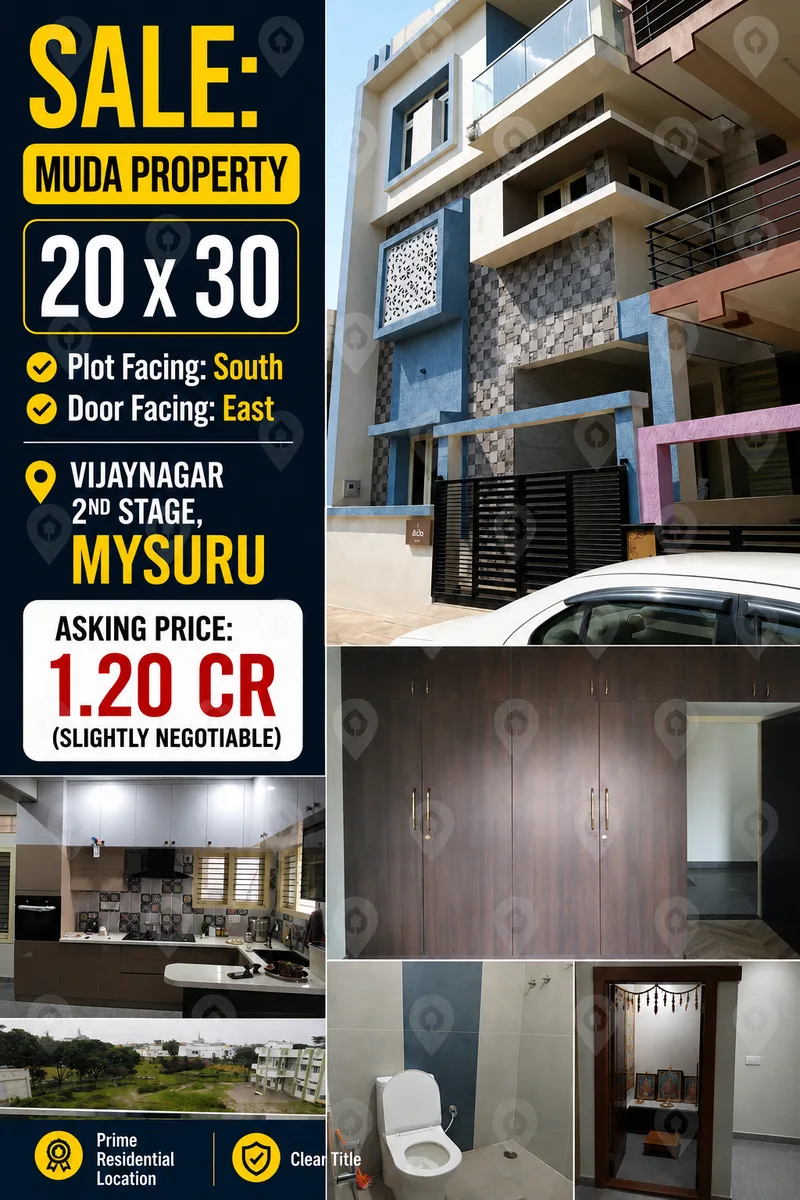
₹1.2 Crore
20 x 30 Triplex House, Vijaynagar 2nd Stage, Mysuru
Vijayanagar 2nd Stage, Mysore
- Independent House
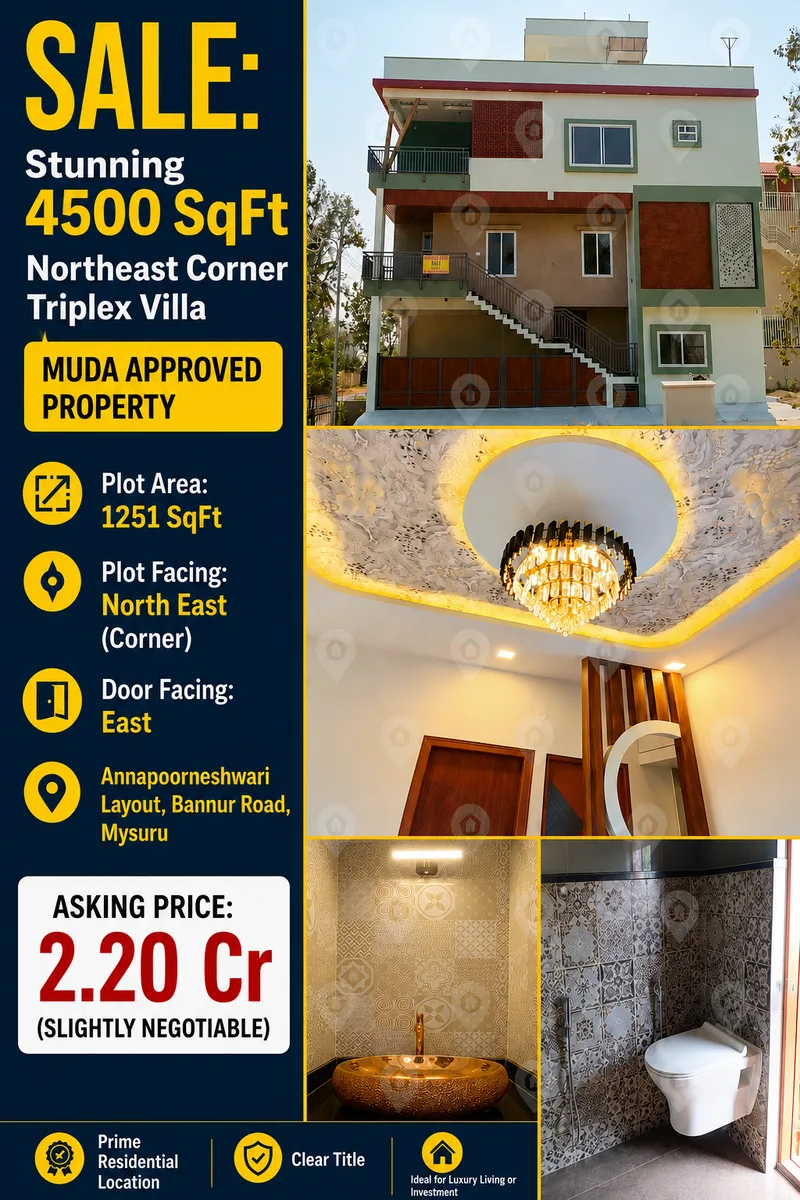
₹2.2 Crore ₹4,889 per sq.ft
Stunning 4500 SqFt Built Triplex Villa, North East Corner on Bannur Road, Mysore
Annaporneshwari Layout, Mysore
- 4,500 sq.ft built-up
- 1,251 sq.ft plot
- Independent House

₹25 Lakh ₹6,250 per sq.ft
20 x 20, MUDA Property, Raghavendra Nagar, Mysuru, Urgent Sale
Raghavendra Nagar, Mysore
- 400 sq.ft plot
- 20 x 20
- Independent House
Want help applying this to your own search?
Send us your requirement and we'll shortlist properties that fit, arrange the visits and flag the things this guide says to check. No platform fee for customers.
Reviewed and updated 27 August 2026. How we research and review guides.