
Khata in Karnataka: A-Khata, B-Khata and e-Khata Explained
The short answer
Khata is the municipal record that identifies who pays property tax on a property. An A khata property is recorded as fully compliant with the local body's requirements; a B khata entry records the property for tax purposes without that full compliance, which can restrict building licences and lending. Khata is not proof of ownership — title comes from the registered deeds.
What a khata is, in one sentence
A khata is the municipal record naming who is liable for property tax on a property. A-khata means the property is fully compliant on that register; B-khata means it is recorded for tax but not fully regularised.
Key takeaways
- Khata is a tax record, not a title document. You need both, and they answer different questions.
- A khata generally makes building licences and bank finance straightforward; B khata can restrict both.
- Ask for the khata certificate and the khata extract, and check which register the property sits on.
- Rules on B khata and its regularisation have changed over time — confirm the current position with the local body rather than relying on what was true a few years ago.
- Khata must be transferred into your name after registration; it does not happen automatically.
Khata comes up in almost every property conversation in Karnataka, and it is routinely misunderstood — including by people selling property. It is worth being precise, because the classification has real consequences for what you can do with a property after you buy it.
What khata actually is
Khata is an account maintained by the local body identifying the person liable to pay property tax on a particular property. It records the property's details and links them to an owner for tax purposes.
It is not a title document. It does not prove ownership, and a khata in the seller's name does not mean the seller can give you clean title. Title is established by the registered deeds, the chain behind them, and a clean encumbrance certificate. Khata sits alongside those, not instead of them.
A khata and B khata
In broad terms:
- A khata — the property is recorded on the main register as compliant with the local body's requirements: approved layout, conversion where applicable, construction within the sanctioned plan, taxes paid.
- B khata — the property is recorded, and tax is collected, but on a separate register, because the property does not meet one or more of those requirements. Common reasons include an unapproved layout, unconverted land, or construction deviating from the sanctioned plan.
The B register exists so that the local body can collect tax on properties it cannot fully regularise. Being on it means tax is being collected — nothing more.
What the difference means in practice
| What you want to do | A khata | B khata |
|---|---|---|
| Obtain a building licence | Standard process | Typically restricted |
| Get a bank home loan | Generally available | Often restricted or declined |
| Obtain water and power connections | Standard process | Can be more difficult |
| Resell | Full buyer pool | Smaller pool; expect a discount and a longer sale |
| Trade licence for commercial use | Standard process | Usually not available |
How to check
- Ask for the khata certificate and the khata extract, both current.
- Check whether the entry is on the A register or the B register — this should be evident on the documents; if the seller is vague about it, treat that as a warning.
- Cross-check the property details on the extract against the deed schedule and the actual site.
- Confirm current property tax receipts with no arrears.
- Where the local body offers online records, verify independently rather than relying on the copy you were given.
Transferring khata after you buy
Khata does not move to you automatically on registration. After the sale deed is registered you apply to the local body for khata transfer, generally with the registered sale deed, the previous khata, tax receipts and the required application. Do this promptly — an untransferred khata causes problems the next time the property changes hands, and the tax record continues to show the previous owner in the meantime.
A note on changing rules
Karnataka has revised its approach to B khata properties and to regularisation more than once, and record systems have been modernised in recent years. What was true when a neighbour bought five years ago may not be true today. Before you rely on any statement about what can be regularised or converted, confirm the current position with the local body for that specific property.
How khata appears on our listings
Where a property on Find My Property shows a khata status, it is as stated by the owner or representative. We publish it because buyers need to know it early, and we ask about it on every property we take on. Verify it yourself through your advocate before completing.
General information, not legal advice. Rules and processes change; take advice from an advocate on the specific property you intend to buy.
What e-Khata is and how it differs
e-Khata is the digital form of the same municipal record. Karnataka has been moving khata issue and transfer online, so the document a buyer is handed increasingly comes from a portal rather than a counter. The legal substance is unchanged — it is still the record of who pays property tax on the property — but the issuing route, the fees and the documents asked for are set by the corporation and change from time to time. Check the current position with Mysuru City Corporation rather than relying on a guide, this one included.
Khata extract, khata certificate and khata transfer
They are three different documents and buyers routinely conflate them. The extract sets out the property's details as they appear on the register. The certificate confirms the property stands in a named person's name. Transfer is the act of moving the khata into the new owner's name after a sale — and it does not happen automatically on registration, which is why so many properties change hands with the khata still in a previous owner's name.
Khata and property tax
The khata is what the corporation uses to raise the property tax demand, so the two travel together. Ask for tax receipts alongside the khata: paid-up tax in the seller's name is the simplest confirmation that the khata is live and belongs to them.
Check it at source
Khata and property tax are municipal records. These are the offices that hold them:
Mysuru City Corporation
The city corporation, responsible for khata and municipal property tax inside city limits.
Mysuru City Corporation — online property tax
Where municipal property tax for Mysuru is paid and past receipts are retrieved.
Kaveri Online Services, Department of Stamps and Registration, Government of Karnataka
The state registration portal — property registration appointments, encumbrance certificates, certified copies and the guidance-value lookup.
Fees, dates and document lists are set by these authorities and change. Where this guide describes a procedure, the notification or the department's own page is the authority — not this page.
Read next
Frequently asked questions
Is khata proof that I own the property?
No. Khata records who is liable for property tax on a property. Ownership is established by the registered title deeds and the chain of transfers behind them, supported by the encumbrance certificate. A seller with khata in their name but a defective title cannot give you good title.
Can I get a home loan on a B khata property?
Often not, or only on restrictive terms. Many lenders limit or decline finance on B khata properties. If you intend to borrow, raise the khata classification with your lender before you pay an advance.
Can B khata be converted to A khata?
Conversion has been possible in certain circumstances, and Karnataka has run regularisation processes at various times with conditions that have changed. Whether it is possible for a specific property depends on why it is on the B register and the rules in force at the time. Check with the local body for the property in question; do not buy on the assumption that it will be straightforward.
What is the difference between the khata certificate and the khata extract?
The certificate confirms that the property is entered on the register in the named person's name — it is what you produce to apply for a licence or a connection. The extract gives the recorded details of the property, such as dimensions and assessed value.
What is khata in Karnataka?
The municipal record of who is liable for property tax on a property. It is not a title document — it records tax liability, not ownership.
What is the difference between A-khata and B-khata?
A-khata denotes a property that is compliant on the municipal register. B-khata records a property for tax purposes without full regularisation, which affects building sanction, loans and resale.
What is e-Khata?
The digital form of the same record, issued online. Substance unchanged; the process, fees and required documents are set by the corporation and change, so confirm the current position with Mysuru City Corporation.
Does registering a sale transfer the khata automatically?
No. Khata transfer is a separate application to the corporation after registration. It is one of the most common loose ends in a Mysuru purchase.
Properties related to this guide
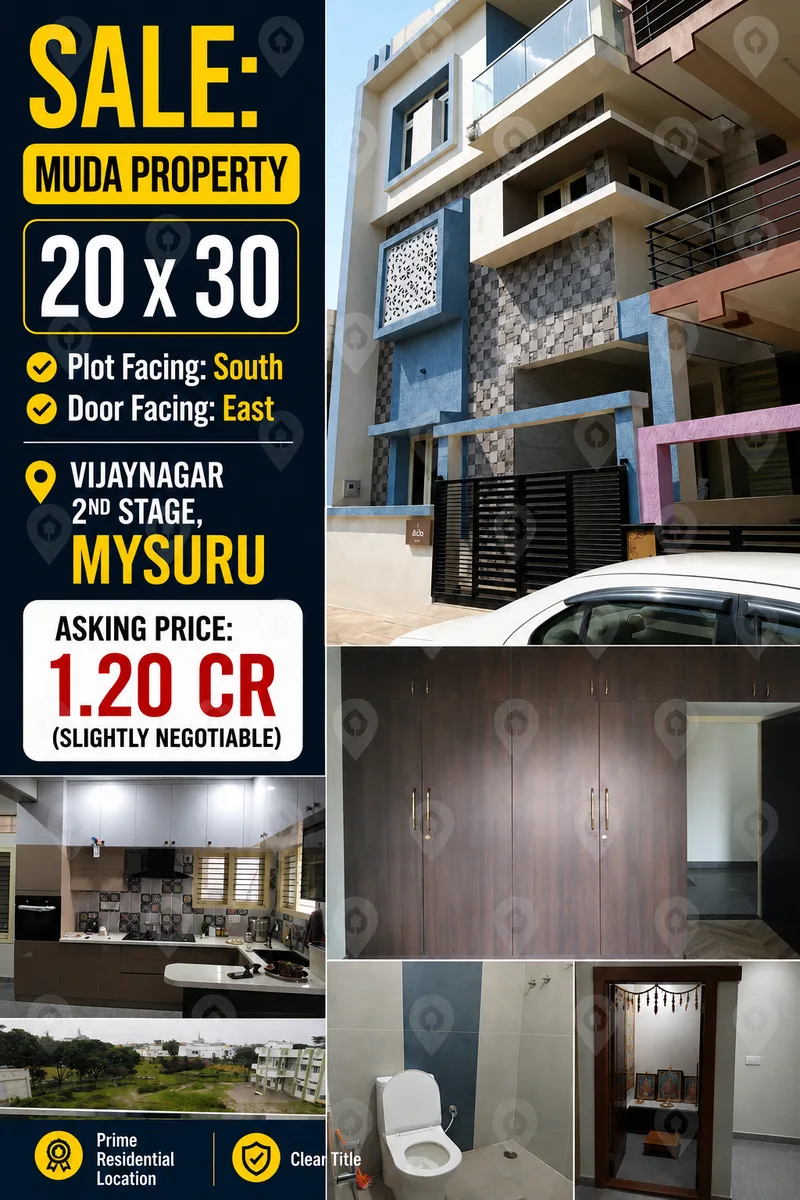
₹1.2 Crore
20 x 30 Triplex House, Vijaynagar 2nd Stage, Mysuru
Vijayanagar 2nd Stage, Mysore
- Independent House
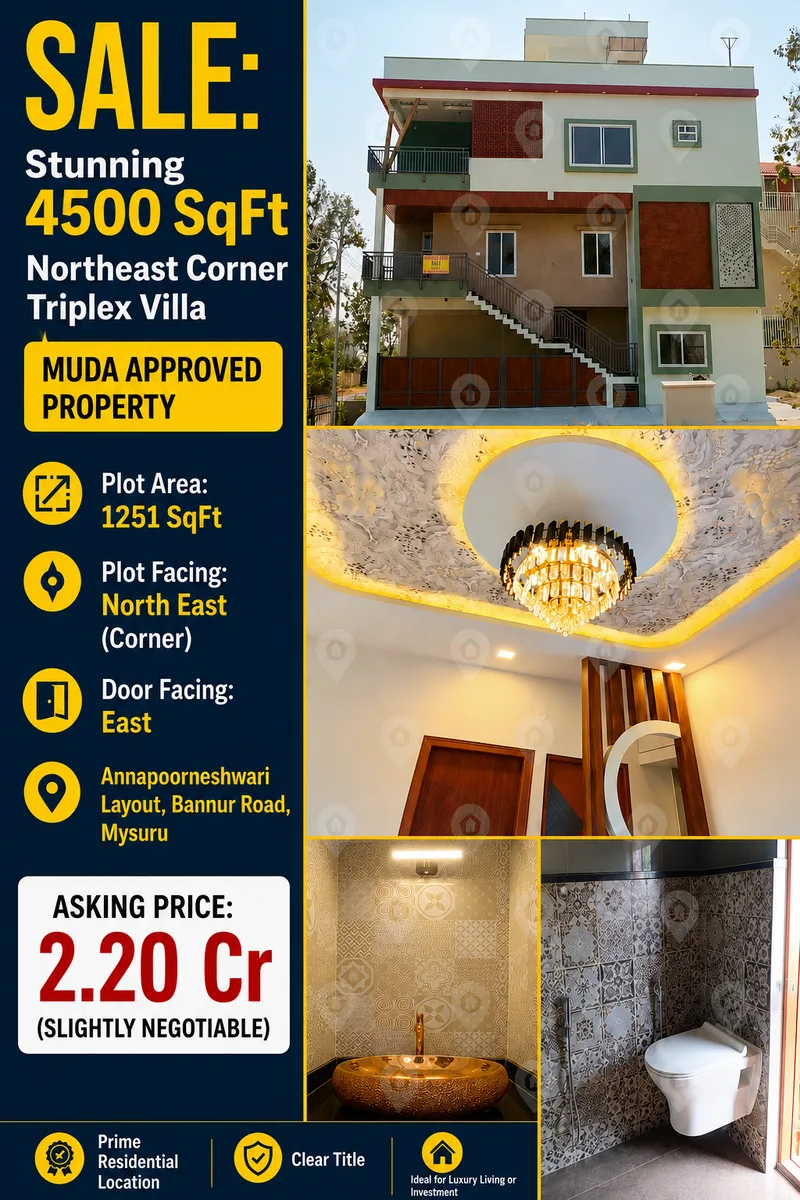
₹2.2 Crore ₹4,889 per sq.ft
Stunning 4500 SqFt Built Triplex Villa, North East Corner on Bannur Road, Mysore
Annaporneshwari Layout, Mysore
- 4,500 sq.ft built-up
- 1,251 sq.ft plot
- Independent House

₹25 Lakh ₹6,250 per sq.ft
20 x 20, MUDA Property, Raghavendra Nagar, Mysuru, Urgent Sale
Raghavendra Nagar, Mysore
- 400 sq.ft plot
- 20 x 20
- Independent House
Want help applying this to your own search?
Send us your requirement and we'll shortlist properties that fit, arrange the visits and flag the things this guide says to check. No platform fee for customers.
Reviewed and updated 27 August 2026. How we research and review guides.