
How to Buy Property in Mysore: A Step-by-Step Guide
The short answer
Buying property in Mysore follows a predictable order: fix your real budget, narrow to two or three areas, shortlist and visit, verify the papers through an advocate, agree terms in writing, register at the sub-registrar office, and take possession with the dues cleared. The part that goes wrong most often is documentation, not price.
The short version
Buying property in Mysore runs in five steps: agree the property and price, verify title, approval and khata, arrange funds, register the sale deed at the sub-registrar, then transfer the khata into your name.
Key takeaways
- Work out your all-in budget first — stamp duty, registration, legal fees and immediate works are real money on top of the asking price.
- Narrow to two or three areas before you start viewing. Buyers who look everywhere take much longer and usually pay more.
- Documentation decides whether a property is safe to buy. Get an advocate to examine the title chain and the encumbrance certificate before you pay anything substantial.
- Never pay an advance without a written agreement that sets out price, timeline and what happens if either side walks away.
- Registration happens at the jurisdictional sub-registrar office. Possession, khata transfer and clearing dues come after.
Buying property in Mysore is not complicated, but it is unforgiving of shortcuts. The buyers who have a bad time are almost never the ones who paid slightly too much — they are the ones who skipped a document check, paid an advance on a handshake, or bought in an area they had only seen once, on a Sunday morning.
Here is the order the process actually runs in.
1. Fix your real budget, not your headline budget
The asking price is not what the property costs you. Before you look at anything, add up:
- Stamp duty and registration charges. In Karnataka these are calculated on the property value on a slab basis, plus registration fee and applicable cess and surcharge. Rates are revised from time to time — check the current schedule for your value band before you budget.
- Legal fees for title verification and drafting.
- Brokerage payable to any third party you have engaged directly.
- Khata transfer and municipal charges after registration.
- Immediate works. Very few resale houses are move-in perfect. Painting, plumbing, electrical work and a water connection add up quickly.
- Loan costs if you are borrowing — processing fee, legal and technical valuation, insurance.
Work backwards from the total you can actually spend. That is your property budget.
2. Narrow to two or three areas
This is the step buyers skip, and it costs them months. Mysore's areas differ far more than the map suggests — in road width, water supply, school access, the age of the housing stock and how much of it is resale versus new.
Pick your areas against your actual constraints, in this order: commute at the time of day you would really travel, schools if you have children, budget, and then preference. Visit each shortlisted area twice — once on a weekday morning and once in the evening. The difference is often the deciding factor.
Our area guides cover what each locality is like, what is available and what to weigh up.
3. Decide what you are actually buying
The three common paths in Mysore:
| Option | Suits | Main risk |
|---|---|---|
| Residential site to build on | Buyers with time, and a clear idea of the house they want | Approval and khata status; construction cost and delay |
| Ready independent house | Buyers who need to move, and want certainty | Hidden condition issues; older title chains |
| Apartment | Buyers who want low maintenance and shared amenities | Builder track record; occupancy certificate; association health |
4. Shortlist and visit properly
Photographs tell you very little. On a visit, check the things photographs cannot show: road width and whether a car can actually turn in, water source (Cauvery connection or borewell), drainage, the neighbours' construction, sunlight at different times, and mobile signal.
Take a measuring tape. Stated dimensions and actual dimensions differ more often than you would expect, particularly on older sites.
If you want someone with you who has seen a hundred of these, that is what our team does — schedule a visit and we will come with you.
5. Verify the documents before you pay anything substantial
This is the step that decides whether the purchase is safe. At minimum, an advocate should examine the title deed and the chain of ownership going back at least thirty years, the encumbrance certificate for the same period, the khata certificate and extract, current tax paid receipts, the approved layout or building plan, and — for land that was agricultural — the conversion order.
Our plot documentation guide goes through each of these in detail, and our MUDA guide explains why approval status matters so much in Mysore specifically.
6. Negotiate, then put it in writing
Asking prices in Mysore are usually negotiable, and the room depends on how long the property has been on the market, why the seller is selling, and whether the paperwork is clean. A property with a documentation problem is not a bargain — it is a liability with a discount attached.
Once you agree terms, an agreement to sell should be drawn up before any advance changes hands. It should state the total consideration, the advance paid, the timeline to complete, who bears which costs, what happens if the buyer withdraws, and what happens if the seller withdraws. Do not pay an advance without this.
7. If you are borrowing, run the loan in parallel
Get a pre-approval before you shortlist, so you know your ceiling. Once you have a specific property, the lender runs its own legal and technical valuation — useful as a second opinion, but not a substitute for your own advocate. Lenders are more cautious about some categories of property than others; ask early rather than discovering it late.
8. Register the sale deed
The sale deed is executed and registered at the jurisdictional sub-registrar office. Both parties (or their properly authorised representatives) attend with identity documents and witnesses. Stamp duty and registration fees are paid at this point. Read the deed carefully before signing — names, schedule of property, measurements and boundaries must all be correct. Errors here are expensive to fix later.
9. After registration
- Transfer the khata into your name with the local body.
- Update property tax records and pay from the current cycle.
- Transfer utilities — electricity connection and water connection.
- Collect the originals — the registered sale deed and the full set of parent documents.
- Obtain the encumbrance certificate post-registration showing the transfer recorded.
Keep everything together. The next buyer will ask for all of it.
Common mistakes we see
- Paying an advance before an advocate has seen the papers.
- Buying on the strength of a single visit at a convenient hour.
- Treating a low price as an opportunity rather than as a question to ask.
- Ignoring road access — a site that a car cannot reach comfortably is much harder to sell on.
- Not budgeting for the costs after the price.
Where we can help
Tell us your budget, area and timeline and we will shortlist what genuinely fits, arrange the visits, and flag the documentation questions to put to your advocate. Customers are not charged a platform fee by Find My Property.
Check it at source
The checks in this guide can all be made against official records:
Kaveri Online Services, Department of Stamps and Registration, Government of Karnataka
The state registration portal — property registration appointments, encumbrance certificates, certified copies and the guidance-value lookup.
Mysore Urban Development Authority (MUDA)
The authority that sanctions layouts, allots sites and publishes e-auction notifications in Mysuru.
Mysuru City Corporation
The city corporation, responsible for khata and municipal property tax inside city limits.
Fees, dates and document lists are set by these authorities and change. Where this guide describes a procedure, the notification or the department's own page is the authority — not this page.
Read next
Frequently asked questions
How long does buying a property in Mysore usually take?
From serious searching to registration, six to twelve weeks is a normal range if the paperwork is clean and you are not waiting on a loan. Title problems, a pending khata transfer or an unresolved encumbrance can add months. Budget more time if you are buying an under-construction property.
Do I need a lawyer to buy property in Mysore?
You should engage one. An advocate examines the title chain, the encumbrance certificate and the approvals, and tells you whether the seller can actually transfer clean title. This is the single highest-value professional cost in the whole process, and it is small relative to what you are buying.
Can I buy property in Mysore if I live outside Karnataka?
Yes. Indian citizens can buy residential and commercial property anywhere in India. You will need to be present for registration or appoint someone through a properly executed power of attorney. NRIs can buy residential and commercial property but not agricultural land, plantation property or farmhouses.
What is the difference between a site and a house for a first-time buyer?
A site is cheaper to enter and gives you control over what gets built, but you carry the construction risk, the time and the interim cost of living somewhere else. A ready house costs more up front and gives you certainty. Which is better depends on whether you have the time and appetite to manage a build.
Properties related to this guide
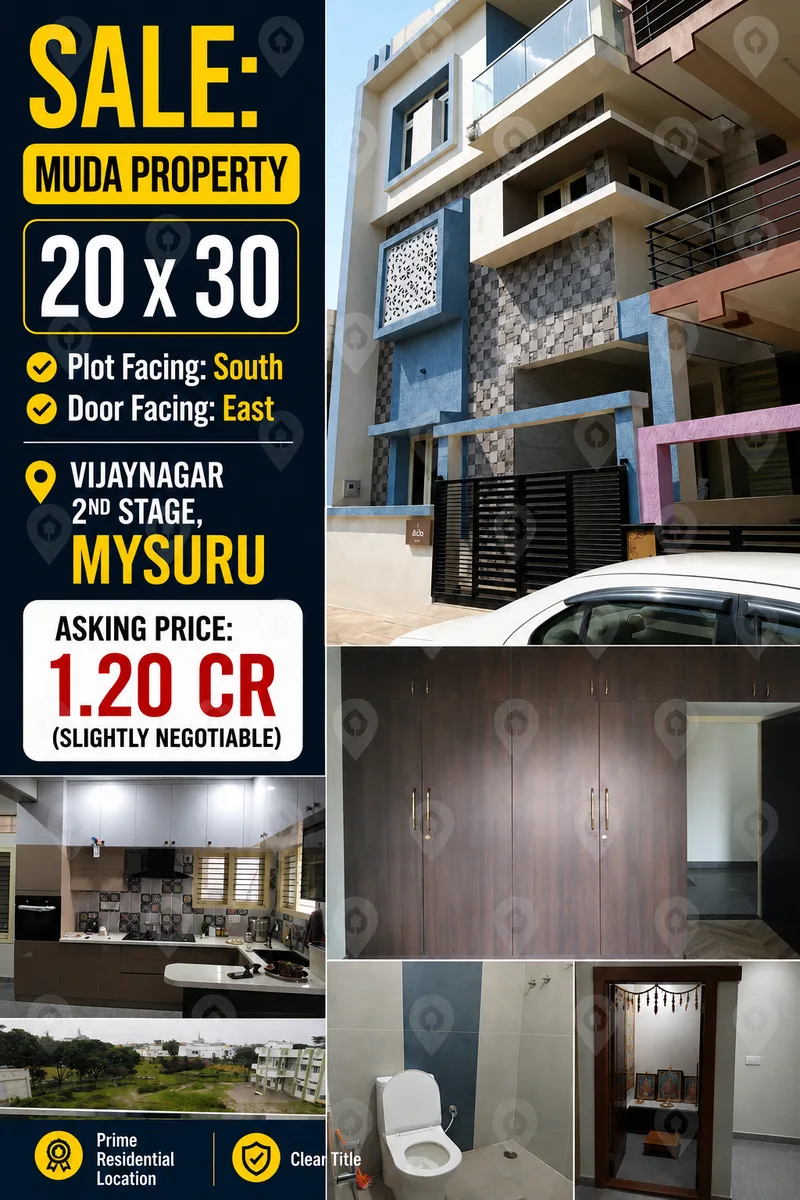
₹1.2 Crore
20 x 30 Triplex House, Vijaynagar 2nd Stage, Mysuru
Vijayanagar 2nd Stage, Mysore
- Independent House
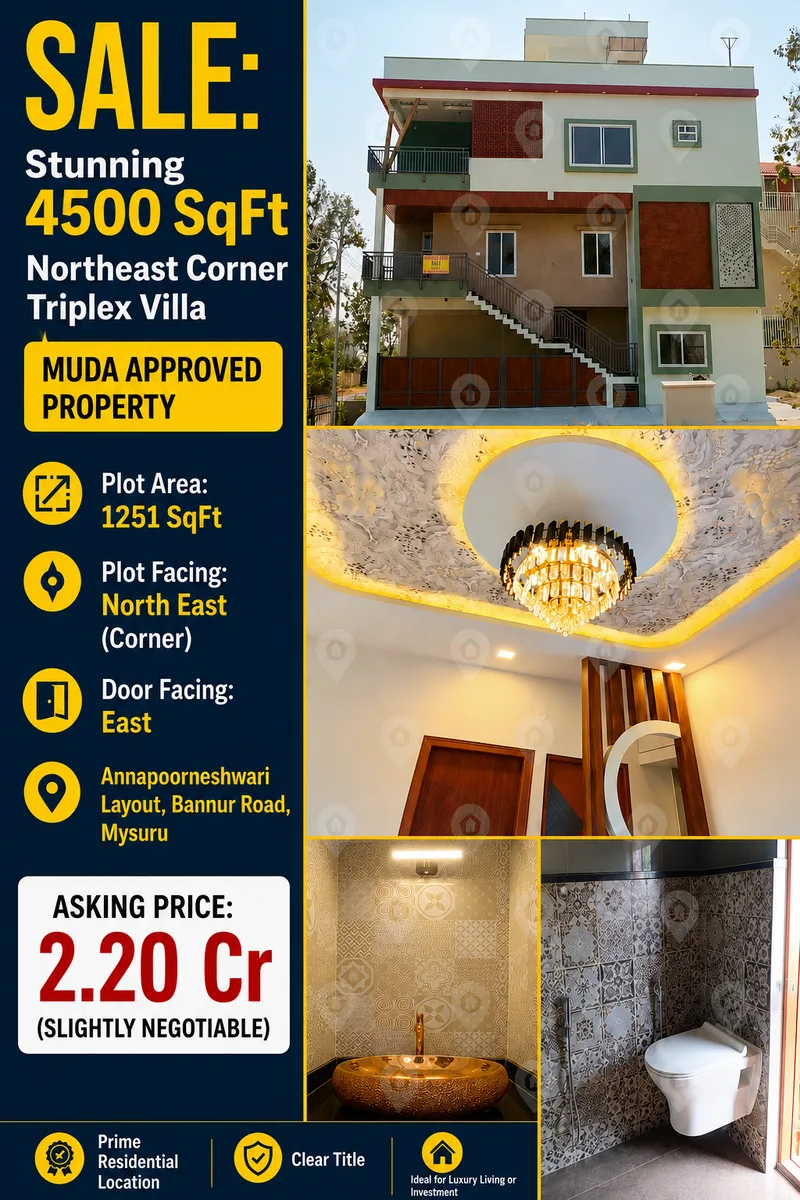
₹2.2 Crore ₹4,889 per sq.ft
Stunning 4500 SqFt Built Triplex Villa, North East Corner on Bannur Road, Mysore
Annaporneshwari Layout, Mysore
- 4,500 sq.ft built-up
- 1,251 sq.ft plot
- Independent House

₹25 Lakh ₹6,250 per sq.ft
20 x 20, MUDA Property, Raghavendra Nagar, Mysuru, Urgent Sale
Raghavendra Nagar, Mysore
- 400 sq.ft plot
- 20 x 20
- Independent House
Want help applying this to your own search?
Send us your requirement and we'll shortlist properties that fit, arrange the visits and flag the things this guide says to check. No platform fee for customers.
Reviewed and updated 27 August 2026. How we research and review guides.