
Buying an Independent House in Mysore: What to Check
The short answer
An independent house in Mysore is bought on three things: the site under it, the structure on it, and the papers behind it. Check dimensions against the deed schedule, find out whether the construction matches the sanctioned plan, establish the water source, and have an advocate examine the title before paying anything.
The short version
An independent house purchase is two purchases at once — the site under it and the structure on it. The site follows the locality; the structure depreciates and should be priced on its condition.
Key takeaways
- You are buying the site as much as the house — dimensions, road width and access matter more than interior finish.
- Ask for the sanctioned building plan and compare it with what has actually been built. Deviations affect khata, loans and resale.
- Establish the water source and the reliability of supply on that street specifically, not for the area in general.
- Older construction is not a problem in itself; unknown older construction is. Get the structure assessed.
- Budget realistically for immediate works — very few resale houses in Mysore are truly move-in ready.
An independent house is the most common purchase we handle in Mysore, and it is also the one where the gap between a good buy and a bad one is widest. Apartments are relatively standardised. Houses are not: two properties on the same street, at the same price, can be very different propositions.
Here is what we look at, in the order we look at it.
1. The site under the house
Over a long enough horizon, the site is the durable part of the asset. Check:
- Actual dimensions against the schedule in the deed. Take a tape. Discrepancies are common.
- Road width in front of the property, and whether a car can enter and turn comfortably.
- Corner or middle site — corner sites usually carry a premium and have their own trade-offs.
- Facing and orientation, and how the house takes light through the day.
- Level relative to the road. A site that sits low will collect water.
- Setbacks — how much open space is left around the construction.
2. The structure
Look for the things that are expensive to fix:
- Cracks — particularly diagonal cracks near openings or at slab junctions.
- Damp patches, efflorescence on walls, staining on ceilings under bathrooms or the terrace.
- The condition of the terrace and its waterproofing, and whether it drains.
- Plumbing age and material; water pressure on the upper floor.
- Electrical work — the distribution board, earthing, and whether wiring has been extended casually over the years.
- Doors and windows: warping, fit, and whether frames have taken water.
If the house is more than a decade old or has been altered, get a qualified person to assess it. The cost is trivial against the purchase price and it gives you a concrete basis for negotiation.
3. Sanctioned plan versus what is built
Ask for the building plan sanctioned by the local body, and walk the house against it. You are looking for deviations: an additional floor, construction into the setback, a covered area that should be open, a converted parking space.
Deviations are common and not always fatal, but they have consequences — for khata classification, for lender appetite and for what the next buyer will pay. You want to know about them before you offer, not after.
4. Water, power and drainage
Ask specifically:
- Is there a municipal Cauvery connection, a borewell, or both? If a borewell, at what depth and what is the yield?
- What is the sump and overhead tank capacity?
- How does the street drain in heavy rain? Ask a neighbour, not the seller.
- Is there an underground drainage connection, or a septic tank?
- Are there arrears on the electricity or water account?
Of everything on this page, water is the item people most often wish they had asked more about.
5. The paperwork
The same core set as for a site, plus the construction documents:
- Title deed and thirty-year chain of ownership.
- Encumbrance certificate for the same period, with release of any past mortgage.
- Khata certificate and extract — see our khata guide.
- Current property tax receipts.
- Approved layout plan and release order — see our MUDA guide.
- Sanctioned building plan; occupancy or completion certificate where applicable.
- Conversion order if the land was agricultural.
The full checklist is in our documents guide. Give the set to an advocate before you pay an advance.
6. The street, not just the house
Visit twice — once on a weekday morning and once in the evening. Check noise, parking pressure, what is being built next door, how far the nearest daily shopping is, and how long the commute actually takes at the hour you would make it. Talk to a neighbour if you can; people are usually candid.
7. What it will really cost
Beyond the price: stamp duty and registration, legal fees, khata transfer, and the works you will do in the first six months. On a resale house, painting, plumbing repairs, electrical updates and deep cleaning are close to inevitable. Price them and put them in your offer calculation rather than discovering them afterwards.
Going with someone who has seen a lot of them
We look at houses in Mysore constantly, and much of the value we add is knowing which question to ask on the doorstep. Book a visit and we will come with you, or send us your requirement and we will shortlist. No platform fee for customers.
Check it at source
Verify the paperwork against the offices that issue it:
Kaveri Online Services, Department of Stamps and Registration, Government of Karnataka
The state registration portal — property registration appointments, encumbrance certificates, certified copies and the guidance-value lookup.
Mysuru City Corporation
The city corporation, responsible for khata and municipal property tax inside city limits.
Fees, dates and document lists are set by these authorities and change. Where this guide describes a procedure, the notification or the department's own page is the authority — not this page.
Read next
Frequently asked questions
Is it better to buy a ready house or a site and build?
A ready house gives certainty of cost and timeline and lets you move immediately. Building gives you exactly the house you want, usually at a lower cost per square foot, but you carry the time, the management burden and the risk of overruns, plus wherever you live during construction. If you do not have the time to supervise a build, buy ready.
What should I check about water supply?
Ask specifically what the house is connected to — a municipal Cauvery connection, a borewell, or both — and ask neighbours what supply is actually like through the year, not just today. Water is the single most common source of regret we hear about after a purchase.
What is a building plan deviation and does it matter?
A deviation is construction that differs from the plan sanctioned by the local body — an extra floor, built area beyond the permitted setback, a covered space that should have been open. It matters because it can affect khata classification, loan eligibility and what a future buyer is willing to pay. Ask for the sanctioned plan and compare.
How old is too old for a house in Mysore?
Age alone is not the issue. Many older Mysore houses are solidly built. What matters is how the structure has been maintained, whether there has been water ingress, the state of the plumbing and wiring, and whether previous alterations were done properly. Have someone qualified look at it and price the works into your offer.
Properties related to this guide
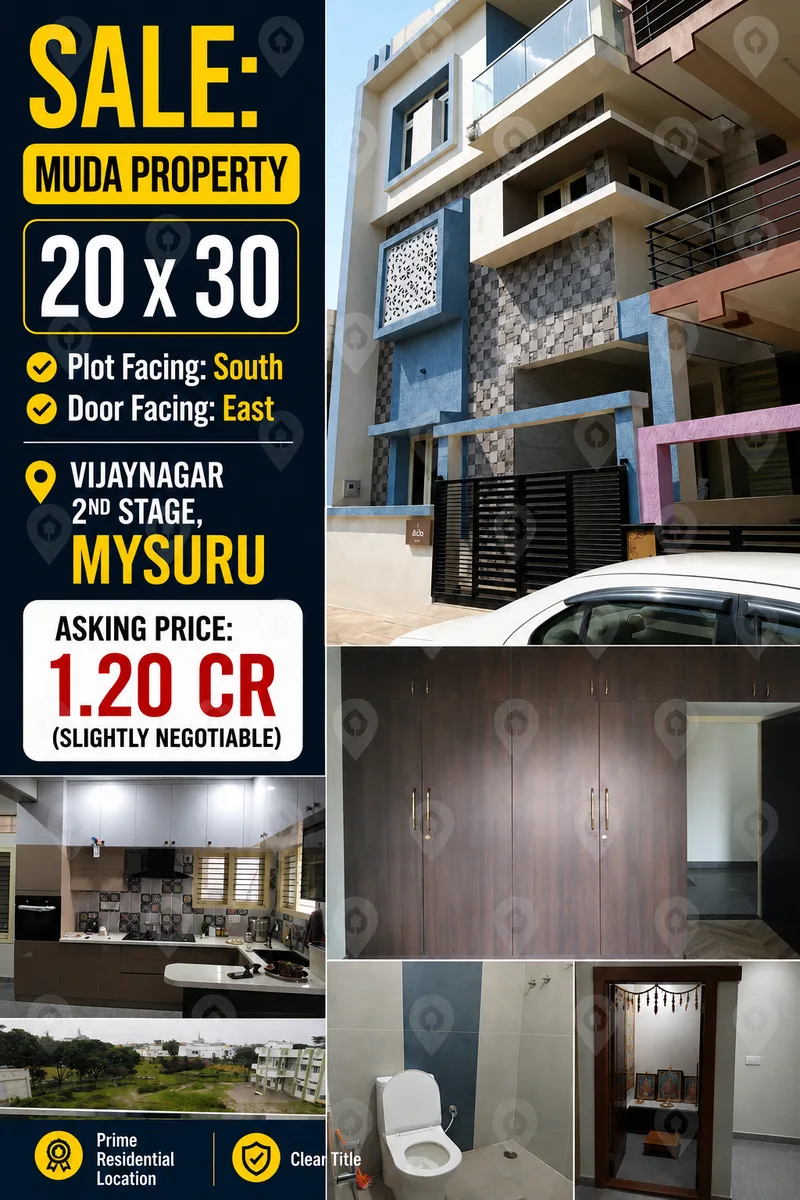
₹1.2 Crore
20 x 30 Triplex House, Vijaynagar 2nd Stage, Mysuru
Vijayanagar 2nd Stage, Mysore
- Independent House
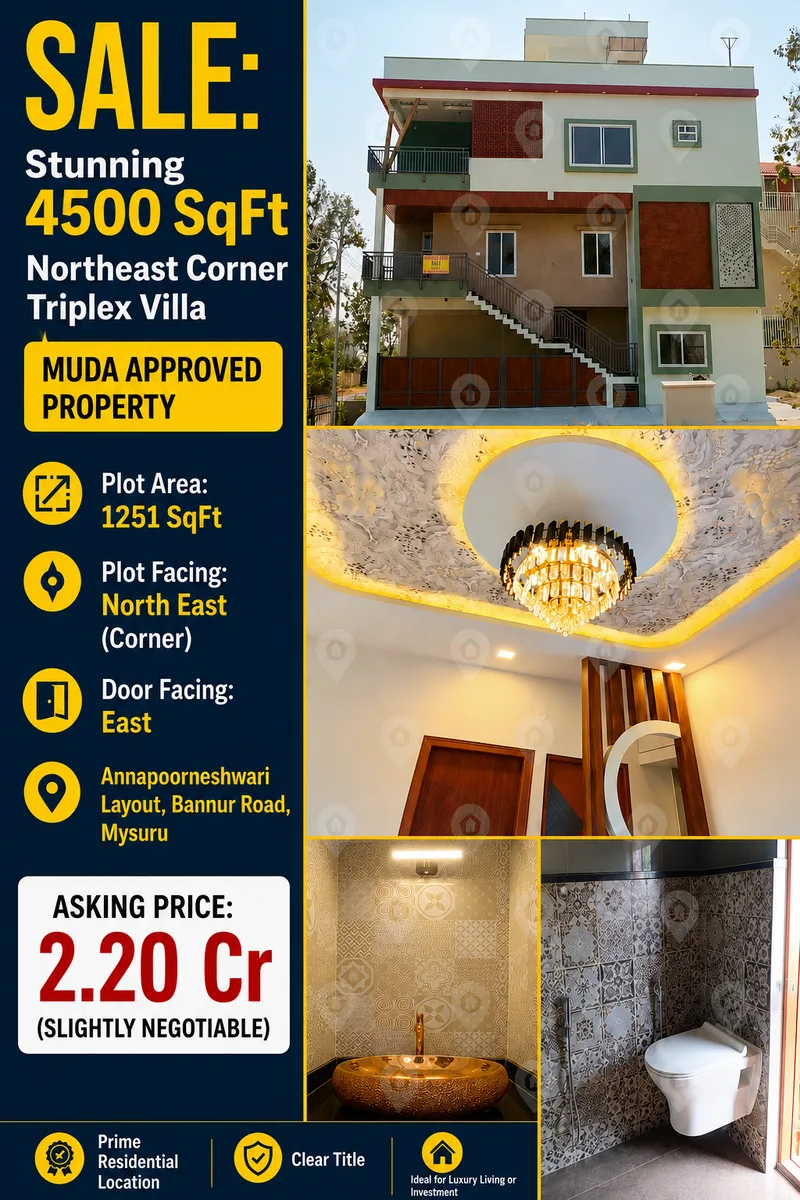
₹2.2 Crore ₹4,889 per sq.ft
Stunning 4500 SqFt Built Triplex Villa, North East Corner on Bannur Road, Mysore
Annaporneshwari Layout, Mysore
- 4,500 sq.ft built-up
- 1,251 sq.ft plot
- Independent House

₹25 Lakh ₹6,250 per sq.ft
20 x 20, MUDA Property, Raghavendra Nagar, Mysuru, Urgent Sale
Raghavendra Nagar, Mysore
- 400 sq.ft plot
- 20 x 20
- Independent House
Want help applying this to your own search?
Send us your requirement and we'll shortlist properties that fit, arrange the visits and flag the things this guide says to check. No platform fee for customers.
Reviewed and updated 27 August 2026. How we research and review guides.